Music Artists Coalition joins Cate Blanchett's OpenAI amicus brief, pointing to ASCAP and BMI as proof AI training can be licensed
My stack My fav 6 tools for AI music after testing 70+
-
 ElevenMusic · Music generation
-
 Moises · Stem separation
-
 Controlla · Voice swap & cloning
-
 Cryo Mix · Mixing + mastering
-
 Neural Frames · Music videos
-
 ONCE · Distribution
Some links are affiliate links — I earn a commission at no cost to you. Every tool here is one I run myself and truly believe in. This stack is proven.
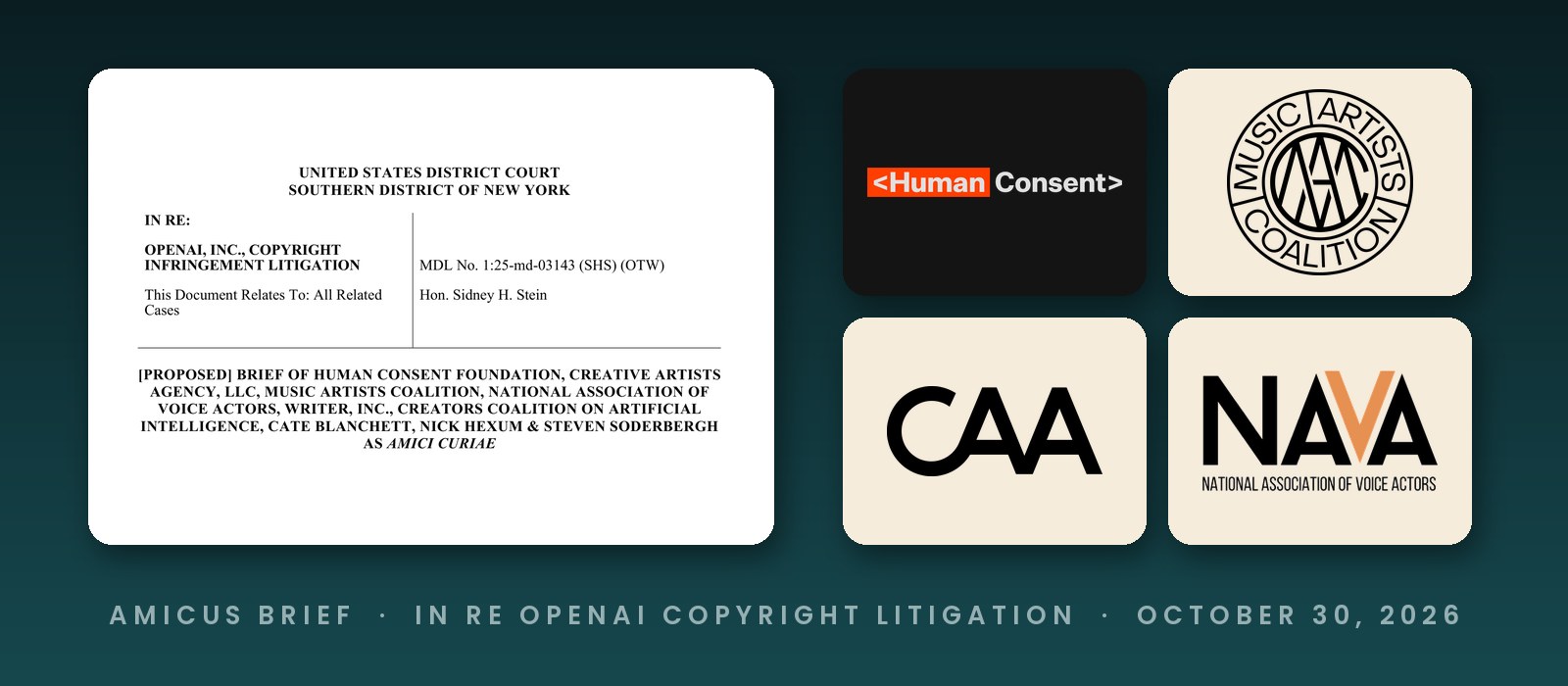
The Music Artists Coalition has joined a 31-page amicus brief telling the judge in the OpenAI copyright case that AI training data can be licensed at scale, the way music has licensed songs for a century. Cate Blanchett’s Human Consent Foundation led the filing on Friday, October 30, 2026, in the consolidated case in New York that includes the New York Times’ lawsuit against OpenAI and Microsoft.
Amicus means friend of the court: groups that aren’t parties to the case but want Judge Sidney H. Stein to hear them before he rules on fair use.
The brief goes after one argument. OpenAI and Microsoft say licensing creative work for training costs too much and that nobody can put a price on training data. The brief’s answer is “The facts demonstrate otherwise,” and most of its facts come from music.
What the Human Consent Foundation brief tells Judge Stein about OpenAI’s licensing argument
Fair use is the defense that lets you copy without permission in some cases, and judges weigh it on 4 factors. The fourth asks whether the copying hurts the market for the original work. Courts count markets that are “traditional, reasonable, or likely to be developed.”
Microsoft says that market can’t work. Its summary judgment brief, as the amicus filing quotes it, says training needs work by “millions of authors” who are too scattered to deal with one by one, and there’s “no settled, workable means of valuing any given piece of training data.”
The Human Consent Foundation brief replies that the creative industries “already have in place a proven infrastructure and workflows to clear rights for dispersed works at scale and cost-effectively.” CAA, the Music Artists Coalition, the National Association of Voice Actors, the Creators Coalition on AI and the enterprise AI company Writer signed it. So did Blanchett, Steven Soderbergh and Nick Hexum, the singer of 311.
The filing doesn’t formally pick a winner, though. Its motion says the amici “take no position on the ultimate disposition” of the summary judgment motions, while the brief calls the defendants’ cost and valuation claims “mischaracterizations.”
What the Music Artists Coalition and Nick Hexum bring to the OpenAI brief
The brief’s first argument is that music solved the “dispersed owner” problem, too many rights holders to ask one by one, long ago. A collecting society hands out one blanket license for a whole catalog, so a radio station never negotiates song by song. The brief lists the scale:
- ASCAP licenses over 20 million musical works for more than 1.1 million songwriters, composers and publishers.
- BMI licenses over 25 million musical works, and Global Music Rights over 134,000.
- CISAC’s 228 member societies represent more than 5 million creators and collect about €14 billion a year.
The idea that AI training data is somehow ‘too complex’ to license ignores the fact that the music industry has been solving this exact problem for generations.
That line comes from Hexum’s statement for the brief, which opens with the mess every co-writer knows: “In the music business, a single track can involve dozens of songwriters, producers, and publishers. It is incredibly complex.”
For a price, the brief points to the NMPA’s template deals with Udio and Klay, which split income 50/50 and which independent publishers can sign onto. It also quotes Björn Ulvaeus’s AI for Good keynote from July 2026.
The Music Artists Coalition was formed in 2019 by music industry figures including Irving Azoff and Coran Capshaw, with artists like Don Henley, Dave Matthews and Meghan Trainor behind it. In April, it also signed the RIAA and NMPA brief in the Anthropic lyrics case. Variety also listed it as a supporter when Blanchett launched the foundation, then called RSL Media, in May.
How does AI training data licensing work, according to the Human Consent Foundation brief?
The brief describes 2 tracks. Big catalogs get custom deals: it cites reports putting the New York Times’ AI licensing deal with Amazon at about $20 million to $25 million a year, and Dotdash Meredith’s deal with OpenAI at about $16 million a year. Everything else, the long tail of songs, recordings and posts, runs through collective licensing and machine-readable registries.
The registry is the new part. HCF runs one built on its Human Consent Standard. In plain words, you post a short, machine-readable statement that says AI can train on your work, can’t, or can on terms like payment. AI systems can then be set up to check it before training, the way YouTube’s Content ID checks uploads against rights owners’ fingerprints.

The brief adds 2 limits. Not posting anything isn’t a yes, because “technical silence is not legal consent.” And every option keeps your right to say no.
What happens next for the Human Consent Foundation brief in the OpenAI case
The filing is a proposed brief, so Judge Stein first decides whether to accept it into the record. In a statement reported by Digital Music News, HCF co-founder and CEO Nikki Hexum said the goal is a market where creators have “a meaningful choice,” including “the choice not to participate.” (The brief lists 311’s Nick Hexum separately, as a co-author of the standard.)
It joins a crowded docket. A day earlier, the AFM, SAG-AFTRA and the Writers Guilds filed against OpenAI’s fair use defense. On October 30, the RIAA, NMPA, A2IM, SONA, the Black Music Action Coalition, the Recording Academy, ASCAP, BMI and the Artist Rights Alliance filed a separate music industry brief backing the plaintiffs.
On the other side, the Justice Department has told the same court that training is fair use. An OpenAI spokesperson pointed Variety to a company blog post listing the briefs that back its position.
Music has its own version of this fight running too: Judge Eumi Lee heard the fair use motions in Concord v. Anthropic, a case over AI lyric training, on October 21, 2026.
Frequently asked questions
Who is Nick Hexum, the musician named in the Human Consent Foundation's OpenAI brief?
Nick Hexum is the lead singer of the band 311 and, per the brief, a co-author of the Human Consent Standard. He signed the October 30, 2026 brief as an individual amicus. Variety and Digital Music News name Nikki Hexum as the foundation's co-founder and CEO, a title the brief does not give him.
Which musicians are listed in Appendix A of the Human Consent Foundation's OpenAI brief?
Appendix A lists 26 supporters, including Madonna, Bette Midler, Ariana DeBose and songwriter Melody Walker, next to Anne Hathaway, Ron Howard and Emma Thompson. The brief says they back its positions, but it is filed only for the organizations plus Cate Blanchett, Nick Hexum and Steven Soderbergh.
Is the Human Consent Foundation's registry free for independent artists?
Yes. When Cate Blanchett and Nikki Hexum launched the project as RSL Media in May 2026, it was announced as a free, public registry where anyone can declare their AI permissions. The October 30, 2026 brief does not name an AI company that checks the registry before training today.
Does the Human Consent Foundation brief ask Judge Stein for a compulsory license on AI training?
No. The brief says the licensing systems it describes should not be read as a compulsory license or a default royalty for AI training. It argues rights holders keep the right to refuse entirely or to negotiate their own terms for high-value work.
About the author

Covering AI music tools, industry shifts, and news for music creators and professionals. Twice-weekly newsletter at aimusicpreneur.com.